
When we talk about dyslexia, the conversation almost always centers around reading, spelling, and decoding words. We discuss phonemic awareness, specialized tutoring, and academic accommodations. While these are absolutely critical components of supporting a dyslexic child, there is another, equally important layer that often goes unaddressed: the social and emotional impact of the learning difference.
For a child with dyslexia, spending seven hours a day in a traditional classroom can feel like running a marathon with a heavy backpack while everyone else is running unhindered. They are often incredibly bright, creative, and capable, yet they find themselves constantly hitting a wall when it comes to the written word. Over time, this daily struggle can chip away at their self-esteem. They might begin to compare themselves to their peers, feeling anxious, frustrated, or mistakenly believing they are simply “not smart.”
At Adaptive Learning Academy (ALA), our foundational belief is that children don’t fail; systems do. When a bright child is falling behind, it is a sign that the environment needs to adapt to them, not the other way around. A massive part of our approach involves nurturing a student’s self-esteem and building their confidence.
Social-Emotional Learning (SEL) is the process through which children understand and manage emotions, set and achieve positive goals, feel and show empathy for others, establish and maintain positive relationships, and make responsible decisions. For children with dyslexia, targeted SEL activities are vital for building the resilience they need to navigate a print-heavy world.
The good news is that you don’t need a degree in special education to foster these skills. Here are five powerful, deeply effective social-emotional development activities for dyslexia that you can easily incorporate into your home routine.
1. Strength-Based “Brain Mapping”
Children with dyslexia spend a disproportionate amount of their day focusing on what they struggle with—reading and writing. It is incredibly important to consciously shift that focus to their strengths. Dyslexic brains are often wired for incredible big-picture thinking, spatial reasoning, empathy, and out-of-the-box problem-solving.
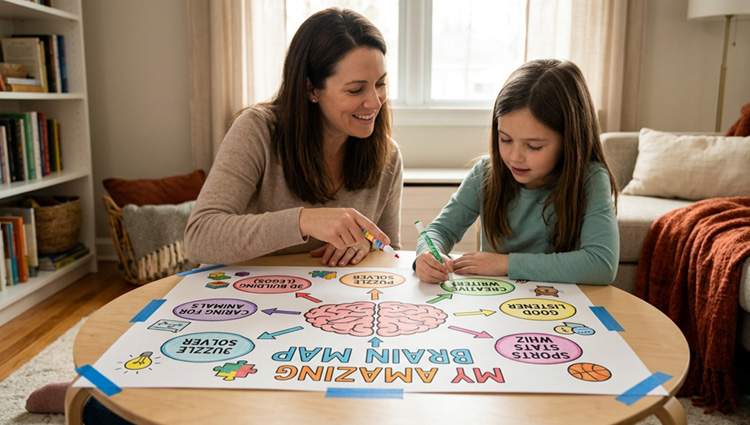
The Activity: Sit down with your child and a large piece of poster board. Draw a picture of a brain (or just a large circle) in the center. Tell your child that you are going to map out all the amazing things their brain is good at.
Ask them questions like:
- “What are you doing when you feel the most proud?”
- “What do your friends ask you for help with?”
- “What can you build, create, or imagine better than anyone else?”
Write or draw these strengths in bright colors all over the map. Examples might include “building Legos,” “remembering sports stats,” “making people laugh,” “drawing,” or “caring for animals.”
The Social-Emotional Benefit: In one corner, acknowledge the hard stuff. Write “Reading out loud” or “Spelling tests” in a smaller font, and explain that while their brain finds these specific tasks tricky, look at how much space their incredible strengths take up. This provides a visual anchor for their self-worth. When they have a tough day at school, you can bring out the Brain Map to remind them of their vast capabilities.
2. The Frustration Thermometer
Because schoolwork requires so much cognitive energy, children with dyslexia often experience intense fatigue and frustration, which can lead to emotional meltdowns at home. Often, by the time they start crying or yelling over homework, they have already bypassed their emotional breaking point.
The Activity: Work together to create a “Frustration Thermometer.” Draw a large thermometer on a piece of paper and divide it into three color-coded zones:
- Green (Bottom): “I feel calm, focused, and ready to try.”
- Yellow (Middle): “I am starting to feel stuck. My brain feels a little tight. I’m getting annoyed.”
- Red (Top): “I am completely overwhelmed. I cannot think. I need to stop.”
Next to each color, brainstorm coping strategies. For Yellow, it might be “Take a 5-minute break,” “Drink a glass of cold water,” or “Ask Mom for help.” For Red, it might be “Close the book and do jumping jacks,” or “Listen to one favorite song in my room.”
The Social-Emotional Benefit: This activity gives your child the vocabulary to express their internal state before it turns into a behavioral issue. It teaches self-awareness and emotional regulation. During homework time, you can gently ask, “Where are you on the thermometer right now?” Empowering them to recognize their own limits is a massive step in social-emotional maturity.
3. Normalizing the “Beautiful Oops”
Children with dyslexia often develop a deep fear of making mistakes because mistakes in reading and writing are so heavily corrected in traditional school settings. To build resilience, you must create a home culture where mistakes are not just tolerated, but celebrated as proof of learning.
The Activity: Incorporate a “Mistake Celebration” into your daily routine, such as during family dinner. Go around the table and have every family member, including adults, share one mistake they made that day and what they learned from it.
Did you burn the toast? Did you send an email to the wrong person at work? Did you trip over the dog’s toy? Share it openly. When your child shares a mistake—whether it’s misspelling a word on a test or forgetting their lunchbox—respond with enthusiasm. “Wow, what a great mistake! What did that teach you?”
The Social-Emotional Benefit: By modeling that adults make and survive mistakes daily, you remove the shame associated with failing. You are rewiring your child’s brain to view errors not as character flaws or signs of low intelligence, but as necessary, normal stepping stones on the path to mastery. This fosters a growth mindset, which is the ultimate armor against academic anxiety.
4. Role-Playing Self-Advocacy Scripts
One of the most crucial skills a neurodiverse student must learn is how to advocate for their own needs. In a classroom of twenty or thirty kids, a teacher may not always notice when a dyslexic child is drowning. The child needs to know how to throw their own life preserver.
The Activity: Set up a low-pressure role-playing scenario at home. You play the role of the teacher, and your child plays themselves. Practice common scenarios that cause anxiety, such as being asked to read aloud, needing more time on a test, or not understanding multi-step written directions.
Give your child specific, polite scripts to use:
- “Could I have a few more minutes to finish this?”
- “I learn better when I hear the instructions. Could you explain the steps to me?”
- “I would prefer to read this silently right now, but I can answer questions about it later.”
The Social-Emotional Benefit: Role-playing builds “muscle memory.” When a child actually finds themselves in a high-stress situation at school, the words will come more easily because they have practiced them in a safe environment. Teaching a child to articulate their needs builds immense confidence and independence.
5. Collaborative, Pen-Free Storytelling
Dyslexia is a mechanical issue with decoding and encoding written language; it is not an imagination or intelligence issue. However, because writing is so arduous, dyslexic children often begin to hate storytelling, compressing their brilliant, complex ideas into short, simple sentences just to avoid having to spell difficult words.
The Activity: Separate the act of storytelling from the mechanics of writing. Dedicate time to collaborative, oral storytelling. You can do this in the car, at bedtime, or while going for a walk.
Start a story with a single sentence: “Once upon a time, a dragon woke up and realized he had lost his fire.” Then, pass the story to your child to add the next sentence. Go back and forth, building a wild, imaginative tale. Alternatively, introduce them to speech-to-text software and let them dictate their stories to a tablet or computer.
The Social-Emotional Benefit: This activity validates your child’s intellect and creativity. It reminds them that they are powerful storytellers and deep thinkers, even if their spelling isn’t perfect. It preserves their love for narrative and language, ensuring that their creative voice isn’t silenced by their struggle with the pencil.
Finding the Right Environment
Trying these social-emotional development activities at home can make a profound difference in your child’s confidence and well-being. However, the environment where they spend the majority of their day matters immensely.
If your child is consistently coming home overwhelmed, exhausted, and feeling defeated by large classrooms that are not built for their learning style, it may be time to consider a change. Traditional schools simply aren’t built for every child, and that is okay.
At Adaptive Learning Academy in Richmond, TX, we offer an inclusive, student-centered micro-school experience specifically designed for students with Dyslexia, Autism, ADHD, and sensory processing needs. Our micro-classrooms eliminate sensory noise and allow our experienced educators to provide personalized attention with a 15-to-2 student-to-teacher ratio.
We bridge grade-level standards with individualized support, ensuring that students master core subjects through strength-based learning. Every student at ALA receives a Personalized Learning Plan (PLP) tailored not just to their academic level, but to their sensory needs, communication style, and social-emotional development.
You don’t have to watch your child’s light dim. If you are ready to see your child smile about school again, contact us today to inquire about enrollment and discover how ALA can empower your neurodiverse learner to reach their fullest potential.