
For parents of young neurodiverse children, watching for communication milestones can sometimes feel like navigating a maze without a map. If your child has been diagnosed with Autism Spectrum Disorder (ASD), or if you are noticing early signs of developmental delays, you might feel a mixture of love, determination, and understandable anxiety about how to best support them.
At Adaptive Learning Academy, we know that traditional, high-pressure environments aren’t built for every child. We also know that children don’t “fail” at communication; sometimes, the environment or the method simply isn’t aligned with their unique neurological profile.
In early childhood, the absolute best way to build communication skills is through play. Play is the natural language of children. It is low-pressure, engaging, and highly motivating. When we shift our focus from “making” a child talk to “inviting” a child to connect, beautiful things happen.
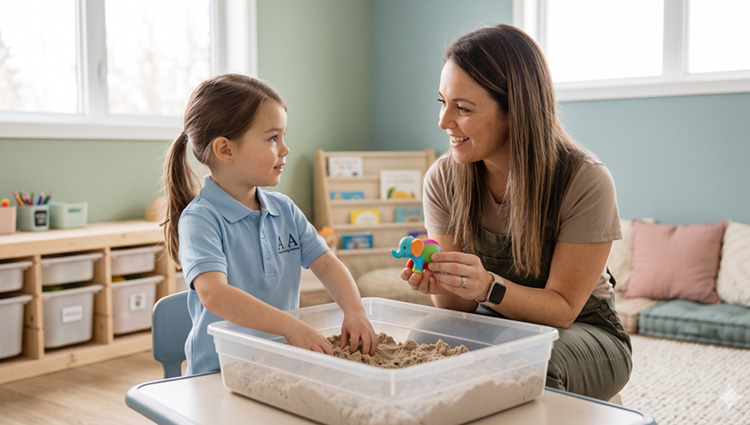
Whether your child is pre-verbal, uses gestures, is beginning to use an Augmentative and Alternative Communication (AAC) device, or is starting to form words, here are seven fun, play-based early childhood communication activities for autism that you can easily try at home.
1. The Power of the Pause: Anticipation Games
One of the most effective ways to encourage communication is by building anticipation. Anticipation games rely on predictable routines that a child loves, which are then playfully interrupted.
How to do it: Blowing bubbles is a classic example. Start by blowing bubbles and letting your child pop them. Show immense joy and excitement. Say, “Ready, set… GO!” and blow the bubbles. Repeat this a few times until your child understands the pattern. Then, introduce the pause. Say, “Ready, set…” and wait. Look at your child with an expectant, warm expression.
The Communication Goal: You are waiting for any form of communication that says, “Do it again!” This could be a sound, eye contact, a giggle, a bounce, pointing, signing “more,” or saying “go.” When they give you that cue, immediately blow the bubbles and celebrate. This teaches the powerful lesson that their actions and communications can directly influence their environment.
2. Sensory Bin Storytelling
Many neurodiverse children thrive with sensory input. At our micro-school, we emphasize sensory-regulated learning environments because a child must feel sensory-safe before they can learn. You can recreate this at home with sensory bins.
How to do it: Fill a shallow plastic container with a sensory base: dry rice, beans, water beads, or kinetic sand. Hide a few of your child’s favorite small toys—like plastic animals, cars, or colorful blocks—inside the base. As your child digs through the bin, narrate their discoveries using simple, clear language.
The Communication Goal: Focus on descriptive words and action verbs. If they pull out a car, you might say, “Vroom! Fast car. Push the car.” If it’s a cow, say, “Moo! Soft cow.” By joining in their sensory play without placing demands on them to speak, you are providing a rich auditory environment that links words to tactile experiences.
3. Musical Fill-in-the-Blanks
Music is processed differently in the brain than spoken language, and many autistic children who struggle with conversational speech demonstrate a remarkable affinity for music and rhythm.
How to do it: Sing familiar, repetitive songs like “The Wheels on the Bus,” “Old MacDonald Had a Farm,” or “Twinkle, Twinkle, Little Star.” Once your child is highly familiar with the song, start singing but leave out the final word of a phrase. For example: “The wheels on the bus go round and…” and then pause, looking at your child.
The Communication Goal: The rhythm and predictability of the song create a natural pull for the child to fill in the blank. Even if they don’t say “round,” they might hum the note, make a gesture, or give you eye contact. Acknowledge and praise any attempt they make to complete the sequence.
4. Playful “Sabotage” (Creating Natural Obstacles)
Sometimes, if a child has everything they need easily accessible, they have no functional reason to communicate. “Sabotaging” the environment in a gentle, playful way creates natural opportunities for them to ask for help.
How to do it: Place your child’s favorite snack or a highly preferred toy inside a clear plastic container with a lid that is securely snapped shut (make sure it’s something they cannot open on their own). Hand the container to your child and wait.
The Communication Goal: When your child realizes they cannot open it, they will need your assistance. They might hand the container back to you, look at you in frustration, grunt, sign “help,” or say “open.” As soon as they initiate communication, model the appropriate word or sign (e.g., “Oh, you need HELP! Let’s OPEN it!”) and immediately open the container. This reinforces that communication is a highly effective tool for solving problems.
5. Visual Choice Boards
For many children on the autism spectrum, receptive language (understanding what is said) and expressive language (communicating their thoughts) can be overwhelming. Visuals bridge this gap beautifully.
How to do it: Create a simple choice board for snack time or playtime. Take photos or print out pictures of two different options—for example, a picture of an apple and a picture of crackers. Hold them up or place them on the table and ask, “Which one?”
The Communication Goal: This activity empowers your child to make decisions and express their preferences without the stress of verbalizing. They can point to the picture, touch it, or hand it to you. This is a foundational step toward more advanced picture exchange communication systems (PECS) and helps reduce the meltdowns that often stem from feeling misunderstood.
6. Mirror Play and Imitation Games
Imitation is a core building block of communication, but rather than asking your child to imitate you, start by imitating them.
How to do it: Sit in front of a large mirror together, or just sit face-to-face. Whatever your child does, gently and playfully copy them. If they tap the floor, you tap the floor. If they make a “babbles” sound, you make the same sound. If they spin a toy car, you spin a toy car.
The Communication Goal: By imitating your child, you are stepping into their world and showing them that their actions have meaning and are worthy of attention. Often, children will begin to notice that you are copying them and will start to experiment—doing something silly just to see if you will do it too. This back-and-forth exchange is the very essence of conversational turn-taking.
7. Cause-and-Effect Exploration
Toys that require a specific action to produce a result are fantastic tools for early communication because they demonstrate that an action has a direct consequence.
How to do it: Use toys like pop-up animals, spinning tops that require a plunger, or musical instruments. Operate the toy for your child a few times so they see how fun it is. Then, hand them the toy, or if it requires adult strength (like winding up a toy), hold it but don’t activate it.
The Communication Goal: Wait for your child to signal that they want the action to continue. You can prompt them by modeling the sign for “more” or saying the word. The goal is to help them understand that they can use their body, their voice, or their gestures to command their environment and keep the fun going.
Fostering Connection Above All Else
When practicing early childhood communication activities for autism, it is vital to remember that connection should always be the primary goal. If an activity is causing frustration for either you or your child, step back. Communication flourishes in environments where a child feels safe, understood, and accepted just as they are.
Celebrate the small victories. A shared smile, an extended gaze, a pointed finger, or a new sound are all massive milestones worth celebrating.
At Adaptive Learning Academy, our Early Childhood program is built entirely around these principles. We provide a sensory-safe, play-based environment that focuses heavily on early communication and emotional regulation. We know that by building confidence and social skills in a highly supportive, specialized setting, we can prepare preschoolers for a lifetime of academic and personal success.
If you are looking for a community that understands your child’s unique neurological profile and is dedicated to strength-based learning, we invite you to explore our micro-school in Richmond, TX. Together, we can unlock your child’s fullest potential.