
When a child has struggled at school for a long time, the effects can go far beyond grades.
They may begin saying things like:
- “I’m not good at this.”
- “I hate school.”
- “I can’t do it.”
- “Everyone else is smarter than me.”
- “I don’t want to try.”
- “What’s the point?”
Sometimes a child who once enjoyed learning begins avoiding homework, becoming anxious before school, shutting down when work becomes difficult, or getting frustrated quickly.
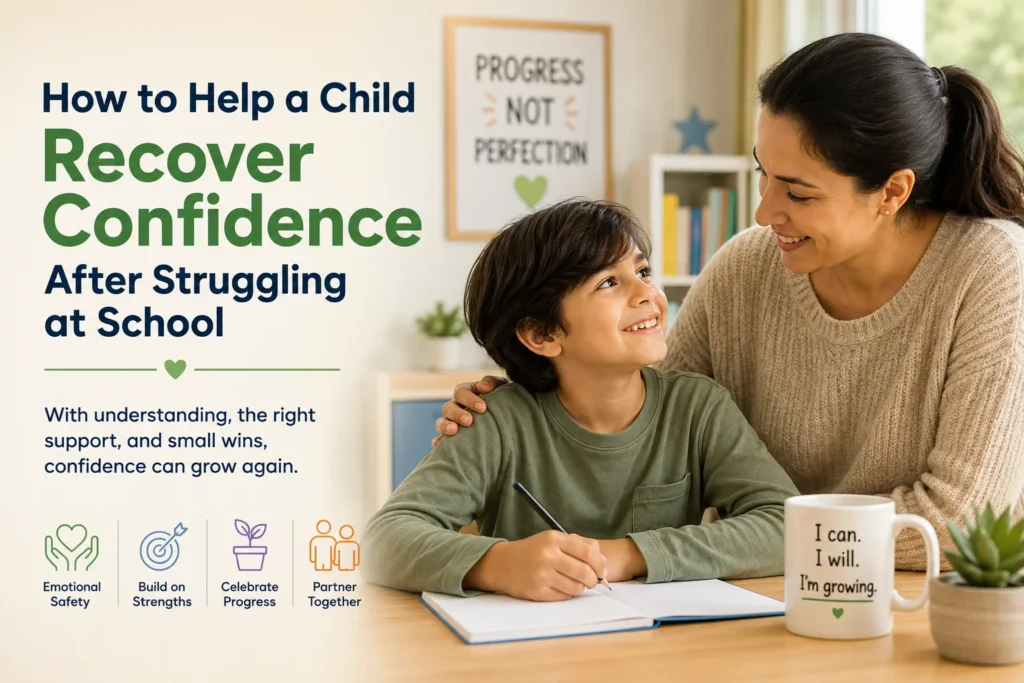
These reactions are not necessarily signs of laziness or a lack of ability. Repeated academic difficulty can affect how children see themselves as learners. For neurodiverse children, this can be especially complicated when the educational environment does not match how they process information, communicate, regulate sensory input, or demonstrate what they know.
The encouraging part is that confidence can be rebuilt.
The goal is not to convince a child that everything is easy. It is to help them experience, again and again, that they are capable of learning, making progress, asking for help, and overcoming challenges in ways that work for them.
Understand What May Have Happened
Before focusing on confidence, it helps to understand why the child lost it in the first place.
A child may have experienced:
- Frequent correction or negative feedback
- Academic work that was consistently too difficult or poorly matched to their learning needs
- Comparisons with classmates or siblings
- Difficulty keeping up with the pace of instruction
- Challenges with attention, reading, writing, language, or executive functioning
- Sensory overload or difficulty regulating emotions in the classroom
- Social difficulties with peers
- Repeated experiences of knowing an answer but struggling to communicate it
- A pattern of completing work incorrectly despite significant effort
When these experiences happen repeatedly, a child may begin to associate learning with frustration, embarrassment, or failure.
This is why simply saying “You need to believe in yourself” is rarely enough.
Confidence is strengthened through experiences.
A child needs opportunities to discover: I can do this. I can improve. I can try something different. I can ask for help. Difficulty does not mean I am incapable.
Stop Defining the Child by the Struggle
One of the most important steps is separating the child’s identity from their academic difficulties.
A child who struggles with reading is not “a bad reader” as an identity.
A child who has difficulty completing assignments is not “lazy.”
A child who becomes overwhelmed is not “difficult.”
A child who needs more time is not “behind” as a measure of their overall potential.
ALA’s philosophy is built around the idea that children should be seen as capable and that education should adapt to the learner rather than expecting every child to fit the same model.
Parents can reinforce this at home by using language that describes the challenge without turning it into a label.
Instead of:
“You’re just not good at math.”
Try:
“This type of math is challenging for you right now. Let’s figure out what kind of support makes it easier.”
Instead of:
“You never pay attention.”
Try:
“It looks like staying focused on this task is difficult today. What could help you get started?”
The difference may seem small, but it communicates an important message: the problem is something we can work on—not who you are.
Give Children Opportunities for Real Success
After repeated failure, giving a child another difficult task and simply encouraging them to “try harder” can sometimes increase frustration.
A better approach is to create opportunities where the child has a reasonable chance of succeeding while still learning something meaningful.
This might mean:
- Breaking a large assignment into smaller steps
- Starting with a skill the child already understands
- Providing appropriate scaffolding
- Offering additional processing time when needed
- Using visual supports
- Connecting learning to the child’s interests
- Allowing different ways to demonstrate understanding
- Gradually increasing the level of challenge
The objective is not to make all work easy.
It is to create a progression in which the child can experience effort → strategy → progress → success.
For example, instead of asking a struggling writer to complete an entire paragraph independently, a teacher or parent might first work on generating ideas, then organizing them, and then writing one section at a time.
Each completed step provides information to the child: I can make progress.
Over time, those experiences can help replace a history of failure with a history of successful problem-solving.
Praise Progress, Strategies, and Persistence
Praise can be helpful, but the most useful praise is specific.
Rather than repeatedly saying:
“You’re so smart!”
Try identifying what the child actually did.
For example:
“You kept working even when that problem was frustrating.”
“You noticed that strategy wasn’t working and tried another one.”
“You remembered the steps without me reminding you.”
“You asked for help when you needed it.”
“Your reading was more accurate today than it was last week.”
This kind of feedback draws attention to behaviors and strategies the child can use again.
It also avoids making intelligence sound like a fixed characteristic that a child either has or does not have.
The message becomes:
Learning is something we can work on.
Let the Child Have a Voice in Their Learning
Confidence grows when children have some sense of ownership.
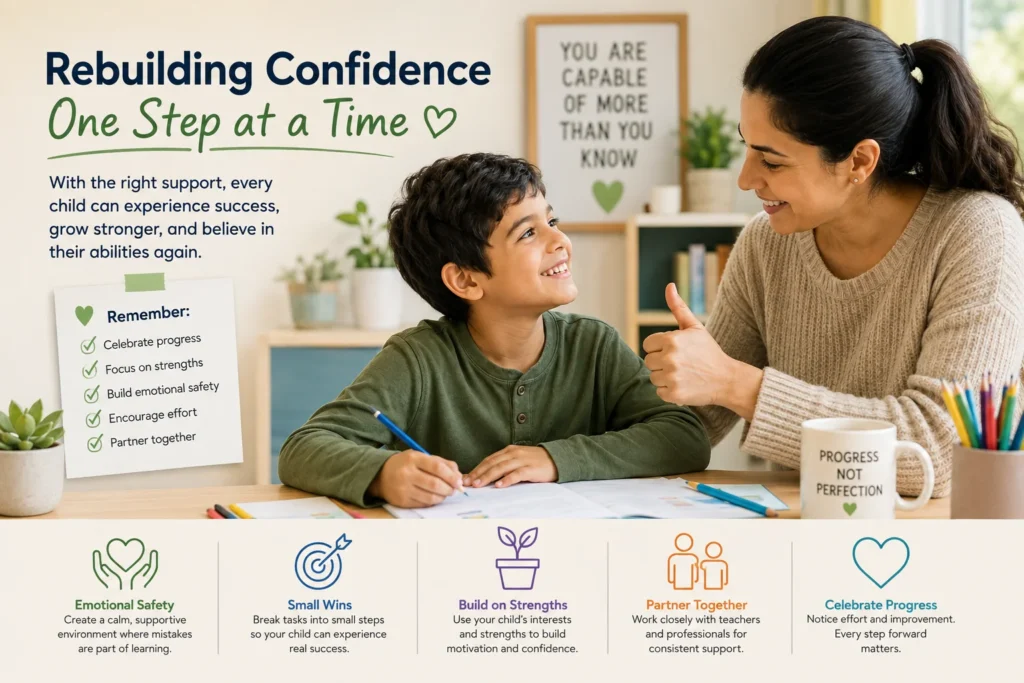
This does not mean allowing a child to avoid every difficult activity. It means involving them in appropriate decisions about how they learn.
Ask questions such as:
- “Which part should we do first?”
- “Would you rather write this down or tell me your answer?”
- “Do you want to work for ten minutes and then take a short break?”
- “What makes this assignment difficult?”
- “What helped you last time?”
- “What do you think we should try differently?”
For neurodiverse learners, understanding individual processing and regulation needs can be particularly important. ALA emphasizes sensory regulation and emotional safety as part of creating conditions in which academic learning can occur.
When children have a voice in identifying what helps them learn, they are also developing an important long-term skill: self-advocacy.
Don’t Confuse Compliance With Confidence
A child sitting quietly and completing an assignment does not necessarily mean the child feels confident.
Likewise, a child who refuses a task may not simply be demonstrating defiance.
Behavior occurs in context.
A child may avoid work because they expect to fail. They may become upset because the task is overwhelming. They may need a different way to access the material. Or they may be experiencing sensory, communication, attention, or emotional challenges that make learning more difficult in that moment.
Instead of asking only:
“How do we get this child to comply?”
It can be more productive to ask:
“What is making this difficult, and what support would allow this child to participate successfully?”
That shift can change the entire learning experience.
Create Emotional Safety Before Expecting Academic Risk-Taking
Learning requires children to encounter things they do not yet know.
That means making mistakes is unavoidable.
A child who has learned that mistakes lead to embarrassment or criticism may become reluctant to take academic risks. Creating an emotionally safe environment can make it easier for children to participate, ask questions, and try again.
Adults can help by:
- Responding calmly to mistakes
- Avoiding humiliation or public comparison
- Normalizing appropriate help-seeking
- Giving feedback privately when possible
- Allowing reasonable time to process questions
- Recognizing when a child is becoming overwhelmed
- Helping the child regulate before returning to challenging work
ALA describes emotional safety as a priority within its neuro-affirming approach.
This is not about removing expectations.
It is about creating conditions in which children can meet expectations without feeling that their worth depends on perfect performance.
Protect Children From Constant Comparison
Comparison can be particularly damaging when a child already believes they are unsuccessful.
Statements such as:
“Your sister never has trouble with homework.”
or:
“Look how quickly everyone else finished.”
may unintentionally reinforce the belief that the child is deficient.
Instead, compare the child primarily with their own previous performance.
Ask:
- What can they do now that they could not do before?
- What strategy have they learned?
- Where has their independence increased?
- What situations are becoming easier?
- What kind of support helps them participate more successfully?
ALA’s leadership philosophy explicitly recognizes that children do not all develop according to the same timeline and that comparison is not a reliable measure of potential.
Make Goals Small Enough to See
“Do better at school” is too broad to give a child a meaningful sense of progress.
Instead, create specific and achievable goals.
For example:
Instead of:
“Improve reading.”
Try:
“Read for 10 minutes three times this week.”
Instead of:
“Stop getting frustrated with homework.”
Try:
“When homework becomes overwhelming, use the agreed-upon break strategy and return to one task.”
Instead of:
“Be more independent.”
Try:
“Pack the homework folder independently each afternoon.”
Small goals are not about lowering expectations permanently.
They provide a way to make progress visible.
And visible progress can matter enormously to a child who has become convinced that they cannot succeed.
Celebrate Strengths Outside Academics, Too
A child’s worth should never depend entirely on school performance.
Children may have strengths in:
- Creativity
- Building and making things
- Music
- Sports
- Animals
- Technology
- Humor
- Problem-solving
- Memory
- Visual thinking
- Helping others
- Persistence
- Special interests
These strengths are not merely distractions from academics.
They are opportunities for children to experience competence.
A child who feels successful in one area may begin to approach other challenges with a greater sense of possibility.
Parents should make room for activities where their child can simply enjoy being good at something without every experience becoming a lesson or an evaluation.
Work With the School, Not Just on the Child
If a child has been struggling for a long time, rebuilding confidence may require changes to the learning environment—not simply more motivation from the child.
Talk with the child’s teachers and support professionals about questions such as:
- What situations consistently trigger frustration?
- When does the child participate most successfully?
- What supports are already helping?
- Is the work appropriately challenging?
- Are there communication or sensory barriers?
- Does the child have opportunities to demonstrate strengths?
- How can adults respond consistently when the child becomes overwhelmed?
- What progress should be monitored?
ALA describes its model as collaborative, with school-based support working alongside families and outside professionals when appropriate.
Consistency matters.
When the adults supporting a child understand the same goals and use compatible strategies, the child does not have to constantly adapt to completely different expectations.
Be Patient With the Recovery Process
Confidence rarely returns overnight.
A child may still say, “I can’t do it,” even after making meaningful progress.
They may resist new opportunities because previous experiences have taught them to expect difficulty.
That does not necessarily mean the approach is failing.
Think about confidence as something built through repeated experiences:
Safety → participation → effort → progress → success → greater willingness to try again.
The process may move forward gradually, and setbacks are normal.
The important question is not whether the child is confident every day.
It is whether they are gradually developing a stronger belief that challenges can be approached with support, strategies, and persistence.
When Additional Support May Be Needed
Sometimes school-related loss of confidence is accompanied by significant emotional or behavioral changes.
Parents should take concerns seriously if a child experiences persistent:
- Anxiety about school
- Withdrawal from previously enjoyed activities
- Sleep difficulties
- Frequent physical complaints associated with school
- Strong emotional distress
- Persistent hopelessness or negative self-talk
- Refusal to attend school
- Significant changes in eating or daily functioning
These signs deserve attention rather than being dismissed as simply a phase or lack of motivation.
A child’s pediatrician, mental health professional, school team, or other qualified professional can help determine what support is appropriate.
If a child talks about wanting to die, self-harm, or not wanting to be alive, seek immediate professional help or emergency assistance rather than treating it as an ordinary confidence issue.
The Goal Is Not to Make a Child Feel Successful. It Is to Help Them Experience Success.
There is an important distinction.
We should not give children empty reassurance or tell them they can do anything if they simply believe hard enough.
Children deserve something more meaningful than that.
They deserve environments in which their challenges are understood, their strengths are recognized, appropriate supports are provided, and their progress is visible.
They deserve adults who can say:
“This is difficult right now, but difficult does not mean impossible. Let’s figure out what works for you.”
That is especially important for children who have spent years being asked to adapt to systems that were not designed around their individual learning needs.
At Adaptive Learning Academy, the philosophy begins with seeing the child as capable. The goal is not to “fix” neurodiversity, but to create an environment that recognizes different ways of learning while supporting academic growth, emotional well-being, and independence.
When children feel understood and supported, they have more opportunity to discover what they can do.
And sometimes, rebuilding confidence begins with something very simple:
Giving a child a genuine opportunity to succeed—and letting them notice that they did.
A Note for Parents
If your child has begun to dread school or believes they are “not good at learning,” you do not have to solve everything at once.
Start by listening.
Ask what feels hardest. Notice when learning goes well. Identify the conditions that help. Celebrate genuine progress. And work with educators and qualified professionals when additional support is needed.
Your child’s educational journey does not have to follow someone else’s timeline.
The right question is not, “Why can’t my child learn like everyone else?”
It is:
“What does my child need in order to learn, participate, and thrive?”
That shift—from changing the child to understanding the learner—can be the beginning of a very different educational experience.