
For many children, knowing what comes next can make the day feel easier. For neurodivergent children, that predictability can be especially meaningful.
A change in classroom activity, an unexpected transition, a substitute teacher, a different route to school, or an unfamiliar social situation can sometimes create additional stress. Predictable routines can provide structure and help children understand what is happening now, what is coming next, and what is expected of them.
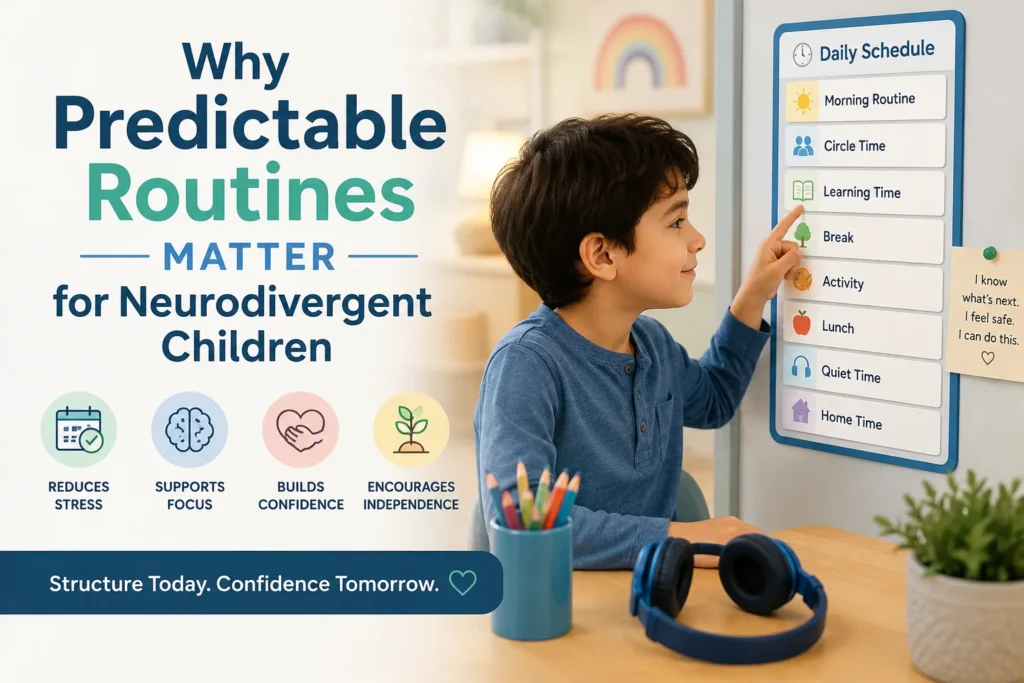
At Adaptive Learning Academy (ALA), this idea is closely connected to our belief that education should adapt to the child—not require every child to adapt to a single system. Our approach emphasizes neuro-affirming practices, sensory regulation, emotional safety, and individualized support for neurodiverse learners.
Predictable routines are not about making every minute of a child’s day rigid. They are about creating enough consistency and clarity that children have a reliable framework from which they can learn, participate, and develop independence.
What Is a Predictable Routine?
A predictable routine is a familiar pattern of activities, expectations, or transitions that a child can anticipate.
For example, a school morning might follow a general sequence:
Arrive → Put belongings away → Check the schedule → Morning activity → Snack → Learning activity → Break
The exact activities can change from day to day. What remains consistent is the basic structure.
Predictability can also be created through smaller routines:
- Giving a child advance notice before a transition
- Using the same visual schedule each day
- Having consistent language for classroom expectations
- Following a familiar arrival routine
- Using a timer or verbal countdown before an activity ends
- Establishing a predictable place for materials
- Creating a consistent bedtime or morning sequence at home
The goal isn’t necessarily to make the environment completely predictable. Life will always involve unexpected events. Instead, routines can give children a stable foundation while they gradually develop the flexibility needed to handle change.
Why Can Predictability Be Helpful for Neurodivergent Children?
Neurodivergent children are not all alike. Autism, ADHD, dyslexia, and other differences can affect children in very different ways, and an approach that helps one child may not help another.
However, research and clinical practice indicate that structure, clear expectations, and appropriate visual supports can be useful for many autistic children and children with other developmental or learning differences.
1. Predictability Can Reduce Uncertainty
Uncertainty requires a child to figure out what is happening and what will happen next.
For some children, this can be particularly demanding.
A child who knows that math comes after morning meeting, for example, doesn’t have to repeatedly wonder what activity is coming next. A visual schedule or familiar sequence can make the environment easier to understand.
This does not mean that every neurodivergent child experiences uncertainty in the same way. Rather, predictable structures can be one useful support when uncertainty is contributing to stress or difficulty participating.
2. Routines Can Make Transitions Easier
Transitions involve more than simply moving from one activity to another.
A child may need to:
- Stop one task
- Shift attention to something new
- Process new instructions
- Move to another location
- Adjust to different sensory input
- Understand a new set of expectations
These changes can be challenging for some children, particularly when they happen unexpectedly.
A consistent transition routine can reduce the amount of information a child has to process at once.
For example:
“Five more minutes” → Timer → Clean up → Check schedule → Move to next activity
Over time, the sequence itself can become familiar.
3. Predictable Environments Can Support Emotional Regulation
Emotional regulation is influenced by many factors, including sleep, sensory experiences, communication demands, environment, stress, and individual temperament.
A predictable routine cannot prevent every episode of distress, nor should distress automatically be viewed as a behavioral problem.
But reducing unnecessary uncertainty may remove one source of stress for some children.
This is particularly important within a neuro-affirming approach. At ALA, sensory regulation and emotional safety are part of the educational philosophy because children are more likely to engage in learning when their individual needs are understood and supported.
4. Routines Can Free Up Attention for Learning
Children have limited attention and cognitive resources.
When a routine is already familiar, a child does not need to spend as much effort figuring out the basic sequence of what to do.
Consider the difference between:
“What am I supposed to do now?”
and
“I know what comes next.”
That difference can matter in a classroom.
Clear routines can make classroom expectations more explicit, allowing educators to spend less time repeatedly explaining basic procedures and more time supporting learning, communication, problem-solving, and independence.
For children with ADHD or learning differences, routines can also provide external structure that supports organization and task completion.
5. Visual Schedules Can Make Expectations Easier to Understand
Not every child benefits from the same type of schedule.
Some children may respond well to spoken instructions. Others may benefit from visual information, written checklists, pictures, symbols, or a combination of approaches.
Visual schedules can be particularly useful for children who have difficulty processing lengthy verbal instructions or remembering multiple steps.
A simple schedule might look like:
1. Morning meeting
↓
2. Reading
↓
3. Break
↓
4. Math
↓
5. Lunch
The schedule doesn’t have to be complicated.
In fact, the best support is often the one the child can understand and actually use.
Predictable Does Not Mean Rigid
This distinction is important.
A predictable routine should not become a system where every unexpected event is treated as a failure.
Children also need opportunities to learn that plans can change.
A healthy approach can be thought of as:
Predictable structure + gradual flexibility
For example, if a child’s usual teacher is absent, an adult might explain the change using clear, simple language:
“Ms. Taylor is not here today. Mr. James will lead the class. The rest of our morning schedule will stay the same.”
The child receives both pieces of information:
Something changed.
Something stayed the same.
This can make unexpected situations easier to understand.
The objective is not to eliminate change from a child’s life. It is to provide enough security and preparation that the child can increasingly cope with change.
How Parents Can Build Predictability at Home
Families do not need elaborate systems to create useful routines.
Start with the parts of the day that are most difficult or unpredictable.
Create a Consistent Morning Sequence
For example:
Wake up → Get dressed → Eat breakfast → Brush teeth → Pack bag → Leave
The exact timing can vary. The sequence provides the structure.
Give Advance Notice of Changes
Instead of suddenly announcing that it is time to leave, provide a warning:
“We are leaving in 10 minutes.”
Then:
“Five more minutes.”
Then:
“It’s time to put shoes on.”
For some children, visual timers or countdowns may work particularly well.
Use a Simple Visual Schedule
A schedule can be placed somewhere the child can easily see it.
For younger children, pictures or symbols may be helpful. Older children may prefer words, checklists, or a digital schedule.
Build Predictable Breaks Into the Day
Breaks don’t necessarily need to happen only after a child becomes overwhelmed.
A planned quiet period, movement break, or sensory-supportive activity may help some children manage the demands of the day.
The appropriate type of break will vary by child.
Prepare for Known Changes
If the family is visiting a new place, changing the usual routine, or attending an appointment, preparation can help.
Parents might:
- Explain what will happen
- Show photographs of the location
- Describe the sequence of events
- Identify what will remain familiar
- Bring a familiar item when appropriate
- Allow additional time for transitions
The goal is to make the unfamiliar a little more understandable.
How Schools Can Use Predictable Routines
Schools can create predictability without creating an inflexible environment.
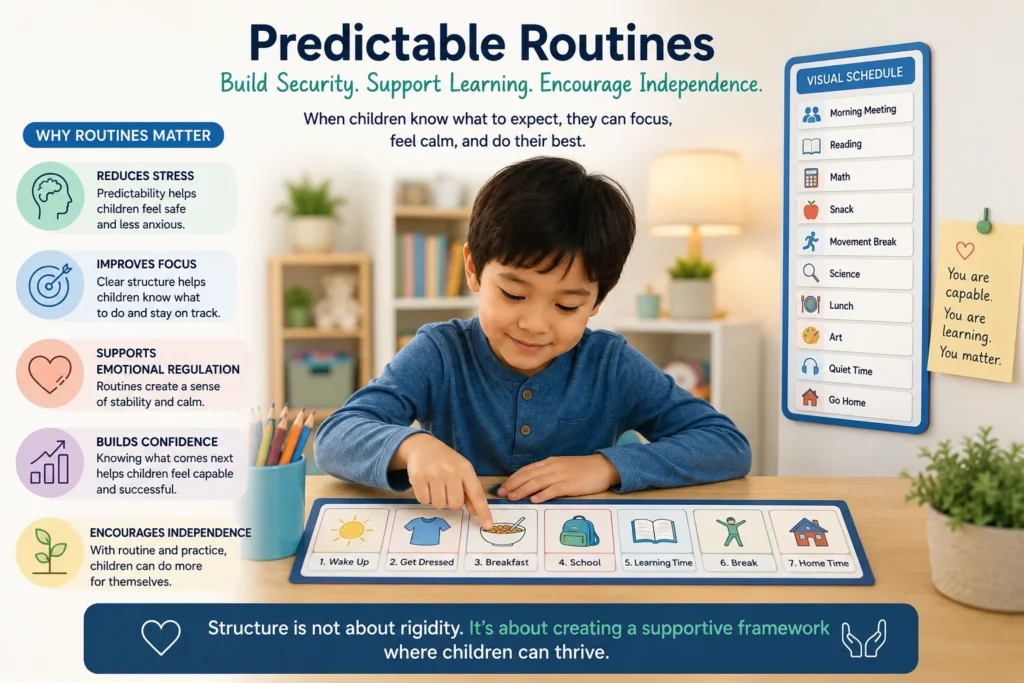
Some practical strategies include:
Post the Daily Schedule
Make the schedule accessible to students and refer to it throughout the day.
Use Consistent Transition Signals
A consistent phrase, sound, timer, or visual cue can signal that an activity is changing.
Explain Changes Clearly
When something unexpected happens, explain what changed and what students should expect instead.
Make Expectations Explicit
Rather than assuming children understand an unwritten classroom rule, explain it clearly and demonstrate it when necessary.
Individualize Supports
A routine that works for one student may not work for another.
Some students may need more visual information. Others may need movement opportunities, additional processing time, shorter instructions, or a quieter environment.
This is one reason individualized support matters.
ALA’s model emphasizes small class sizes, specialized expertise in areas including Autism, ADHD, and Dyslexia, and collaboration with families and therapists. These features can make it easier for educators to understand individual learning and regulation needs rather than relying exclusively on a one-size-fits-all approach.
What If a Child Becomes Distressed When the Routine Changes?
This is where flexibility matters.
If a child becomes upset when a routine changes, the response should focus on understanding what the child is communicating and identifying the support they need.
Ask:
- Was the change unexpected?
- Was the child given enough information?
- Was the transition too fast?
- Was the environment particularly noisy, crowded, or stimulating?
- Was the child tired, hungry, or already overwhelmed?
- Was the instruction clear?
- Does the child have a reliable way to communicate discomfort or ask for help?
Rather than simply asking, “How do we stop this behavior?”, it can be more productive to ask:
“What is making this situation difficult, and what support would make it more manageable?”
That shift is consistent with a neuro-affirming perspective: the child’s communication, sensory needs, and individual differences should be taken seriously rather than assuming that the child simply needs to conform.
Routines Should Support Independence—Not Dependence
One of the most valuable long-term purposes of a routine is helping children gradually do more for themselves.
Initially, an adult may guide a child through every step:
“Check your schedule. What comes next?”
Eventually, the child may learn to check the schedule independently.
The adult’s role can gradually decrease as the child’s independence increases.
This might look like:
Adult prompt → Visual cue → Child checks independently → Child completes routine independently
The same principle can apply to getting ready for school, organizing materials, completing homework, transitioning between activities, and following classroom procedures.
Predictability becomes a tool for independence rather than a permanent requirement for adult assistance.
A Balanced Approach: Structure Without Restriction
The most useful routines are not necessarily the most detailed ones.
Children need structure, but they also need opportunities to make choices, solve problems, tolerate manageable changes, and develop confidence in unfamiliar situations.
A supportive routine might therefore include both:
Things that stay consistent
- Morning sequence
- Classroom expectations
- Visual schedule
- Transition cues
- Regular opportunities for breaks
Things that can vary
- Which book a child chooses
- Which activity comes first within an allowed range
- Who they work with
- What they do during free time
- Small, planned changes introduced with preparation
This combination can provide a sense of security while still allowing children to practice flexibility.
Every Child’s Routine May Look Different
There is no universal routine that works for every neurodivergent child.
One child may thrive with a detailed visual schedule. Another may find too many visual elements overwhelming.
One child may need frequent movement breaks. Another may prefer quiet time.
One child may transition easily with a verbal warning. Another may need a visual countdown and additional preparation.
That is why understanding the individual child matters.
At Adaptive Learning Academy, the underlying philosophy is that there is no universal timeline for learning and that education should adapt to each student’s strengths, needs, and pace.
Predictability is therefore not about forcing every child into the same routine.
It is about creating an environment where children can understand what is happening, know what is expected, feel supported through transitions, and gradually build the skills they need to navigate an unpredictable world.
Final Thoughts
Predictable routines can be a simple but powerful support for many neurodivergent children.
They can help make expectations clearer, reduce unnecessary uncertainty, support transitions, and create opportunities for greater independence. But routines work best when they are individualized and flexible rather than rigid.
Most importantly, predictability should not be used to make a child appear “more typical.” It should be used to make their environment more understandable and accessible.
When adults take the time to understand how a child processes information, experiences sensory input, communicates, and responds to change, routines can become more than a schedule.
They can become a foundation for confidence.
At Adaptive Learning Academy, this reflects a broader commitment to creating an educational environment where neurodiverse learners are seen as capable and supported as individuals. Our goal is not simply academic progress, but helping children develop confidence, emotional resilience, and independence.
Because when children know what to expect, they can spend less energy trying to understand the environment—and more energy learning, connecting, and growing.
A Note for Parents and Educators
Predictable routines are a support, not a treatment for autism, ADHD, dyslexia, or any other neurodevelopmental difference. If a child is experiencing significant distress, difficulties with daily functioning, or challenges with transitions, families should consider discussing their concerns with the child’s pediatrician, psychologist, occupational therapist, speech-language pathologist, educator, or other appropriately qualified professional.
Every child is different, and supports should be individualized to the child’s needs, communication style, strengths, and preferences.