
Every child learns differently. Some children need more time to process new information. Others learn best when they can move, see, hear, touch, or practice a concept repeatedly. A child may understand a lesson but struggle to demonstrate that understanding in a traditional classroom. Another may be academically capable but find sensory demands, transitions, communication, or emotional regulation difficult.
These differences do not mean a child cannot learn. They mean the learning environment and approach may need to be adapted.
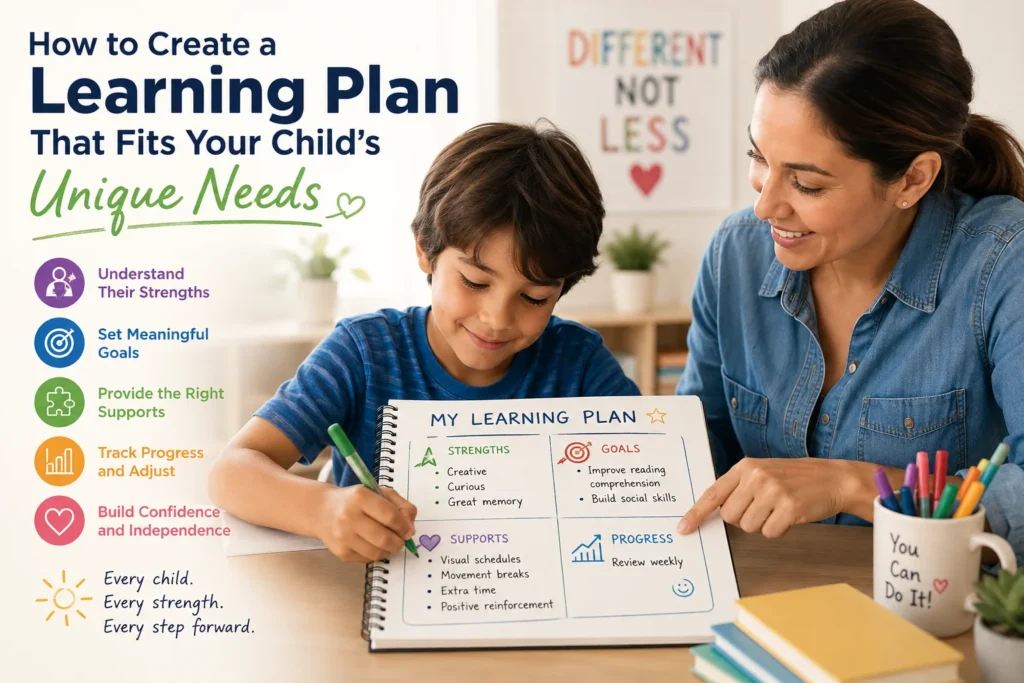
At Adaptive Learning Academy (ALA), this belief is central to our approach: education should adapt to the child, rather than expecting every child to adapt to the same educational model. ALA’s philosophy is grounded in neuro-affirming practices that recognize cognitive differences, prioritize emotional safety and sensory regulation, and support each student’s strengths and development.
One practical way families and educators can put this philosophy into action is by developing a learning plan that reflects the child’s individual needs.
What Is an Individualized Learning Plan?
A learning plan is a practical roadmap for supporting a child’s education. It identifies what the child is working toward, what supports may help, how progress will be observed, and when the plan should be reviewed.
A useful learning plan should consider more than academic performance.
For a neurodiverse child, it may also address:
- Communication preferences
- Attention and engagement
- Sensory needs
- Emotional regulation
- Social participation
- Executive functioning
- Strengths and interests
- Independence and daily routines
- Classroom accommodations
- Family and professional input
The goal is not to create a list of everything a child finds difficult. Instead, the goal is to understand how the child learns best and what conditions help that learning happen.
Start With the Child’s Strengths
A strong learning plan should begin with strengths—not deficits.
Ask questions such as:
- What subjects or activities does my child enjoy?
- What topics naturally capture their attention?
- How do they prefer to communicate?
- What skills do they demonstrate confidently?
- When do they appear most engaged?
- What motivates them to participate?
- What environments help them feel comfortable and successful?
Interests can provide useful pathways into learning.
For example, a child who loves animals might engage more readily with reading passages about wildlife, math problems involving animals, or writing activities connected to a favorite species.
This does not mean every lesson needs to revolve around the child’s interests. Rather, interests can be one tool for increasing relevance, motivation, and engagement.
Identify How Your Child Learns Best
There is no single learning method that works for every child.
Instead of asking, “What learning style does my child have?” it can be more useful to ask:
What conditions help my child successfully understand, practice, and demonstrate a skill?
Consider whether your child benefits from:
- Visual instructions
- Demonstrations and modeling
- Verbal explanations
- Hands-on activities
- Breaking larger assignments into smaller steps
- Repetition and additional practice
- Extra processing time
- Movement opportunities
- Predictable routines
- Frequent feedback
- Assistive technology
- Alternative ways to demonstrate understanding
These supports should be based on the child’s observed needs rather than assumptions about a diagnosis.
For example, two children with ADHD may have very different learning needs. One may benefit from movement breaks and shorter tasks, while another may need help organizing materials and initiating assignments.
Similarly, two autistic children may have very different communication, sensory, academic, and social needs.
A diagnosis can provide important information, but it does not tell the whole story of an individual child.
Consider Sensory and Emotional Needs
Academic learning does not happen in isolation.
A child who is overwhelmed by noise, lighting, crowds, unexpected changes, or other sensory experiences may have difficulty concentrating on an otherwise appropriate lesson.
This is why sensory regulation and emotional safety are important parts of ALA’s educational philosophy.
When creating a learning plan, look for patterns.
Ask:
- What situations appear overwhelming?
- Are there particular sounds, textures, lights, or environments that cause difficulty?
- Does my child need a quiet space?
- How do transitions affect them?
- What helps them return to a regulated state?
- Are expectations communicated clearly and consistently?
- Does the child have appropriate opportunities for breaks or movement?
The purpose is not to remove every challenge from a child’s environment. Instead, appropriate supports can help make learning accessible while gradually developing skills for navigating everyday situations.
Turn Broad Goals Into Specific Goals
“Improve reading” is a broad goal.
A more useful learning goal describes the specific skill the child is developing.
For example:
Broad goal:
Improve reading.
More specific goal:
Build accuracy and comprehension when reading grade-appropriate passages, using appropriate supports as needed.
The same principle applies to other areas.
Instead of:
Improve independence.
Consider:
Increase the number of steps the child can complete independently during a familiar classroom routine.
Instead of:
Improve communication.
Consider:
Increase opportunities for the child to communicate wants, needs, questions, and responses using their preferred communication method.
Specific goals make it easier for parents and educators to determine whether a support is helping.
Separate the Goal From the Support
One helpful distinction when creating a learning plan is the difference between what the child is learning and how the child is supported while learning it.
For example:
Learning goal:
Complete a multi-step math problem-solving task.
Possible supports:
- Written directions
- Problems divided into smaller steps
- Worked examples
- Additional processing time
- Opportunities to explain the answer verbally or through another appropriate communication method
The support does not necessarily lower the learning expectation. It can provide an appropriate pathway for the child to access the task.
This distinction can help families avoid the misconception that accommodations mean “making things easier.” In many situations, accommodations are intended to improve access to learning without changing the underlying skill being addressed.
Build in Flexibility
Children do not perform exactly the same way every day.
Sleep, stress, sensory overload, illness, changes in routine, medication changes, family circumstances, and many other factors can affect attention, regulation, and performance.
A learning plan should therefore provide structure without becoming rigid.
For example, a plan might establish a consistent routine while allowing reasonable flexibility in:
- The amount of time spent on a task
- The order in which activities are completed
- Breaks
- The environment
- The method used to demonstrate understanding
- The amount of prompting provided
Flexibility does not mean abandoning expectations. It means recognizing that the path toward a goal may need to change while the goal remains meaningful and appropriate.
Include Independence in the Plan
Academic achievement is important, but a child’s education should also prepare them for greater independence.
ALA’s stated mission emphasizes fostering independence rather than expecting students to follow rigid, universal timelines.
Depending on the child’s age and developmental needs, independence goals might include:
- Beginning an assignment with less prompting
- Organizing school materials
- Following a familiar routine
- Asking for help
- Communicating when something is difficult
- Making choices
- Managing transitions
- Using appropriate self-regulation strategies
- Completing portions of daily tasks independently
Independence should be developed gradually. A child may initially need substantial adult support before being able to complete a task with fewer prompts.
Work With the People Who Know Your Child
Parents and caregivers see aspects of a child’s development that educators may not see. Teachers observe the child in an educational setting. Therapists may provide additional expertise related to communication, occupational skills, behavior, or other areas.
Bringing these perspectives together can create a more complete picture.
ALA describes its approach as collaborative, including coordination with its in-house ABA support team and external providers such as speech and occupational therapy, with the goal of maintaining consistency between school, home, and clinical settings.
When appropriate, families can ask:
- What strategies are working at school?
- What works at home?
- Are the same communication approaches being used consistently?
- What skills are currently being targeted?
- What changes have been observed?
- Are there conflicting expectations between settings?
- What should we try next?
Collaboration is particularly valuable when a child receives support from several professionals.
Track Progress Without Obsessing Over Perfection
A learning plan should be reviewed using actual observations and evidence.
Depending on the goal, progress might be reflected in:
- Work samples
- Teacher observations
- Skill checklists
- Frequency of a behavior or skill
- Accuracy
- Level of prompting required
- Ability to generalize a skill to another setting
- Increasing independence
- Student participation or engagement
Progress is not always linear.
A child may make rapid progress in one area while needing considerably more time in another. A temporary regression does not necessarily mean that a child has lost their ability to learn.
Regular review allows parents and educators to ask an important question:
Is the current approach helping this child make meaningful progress?
If not, the plan may need to change.
Avoid Comparing Your Child’s Timeline With Someone Else’s
One of the most important principles in individualized education is remembering that development does not follow one universal timeline.
ALA’s Director of Education, Azmae Bhatti, describes this philosophy through both her professional experience in special education and her personal experience as a mother of triplets who developed at different paces. The academy’s approach emphasizes individual strengths and independence rather than comparison or rigid timelines.
A child’s progress should therefore be considered in relation to their own development and goals, not simply compared with siblings, classmates, or standardized expectations.
Comparisons can sometimes obscure meaningful progress.
A child who moves from requiring constant adult assistance to completing part of a routine independently has made meaningful progress—even if another child reached that milestone earlier.
A Simple Framework for Creating Your Child’s Learning Plan
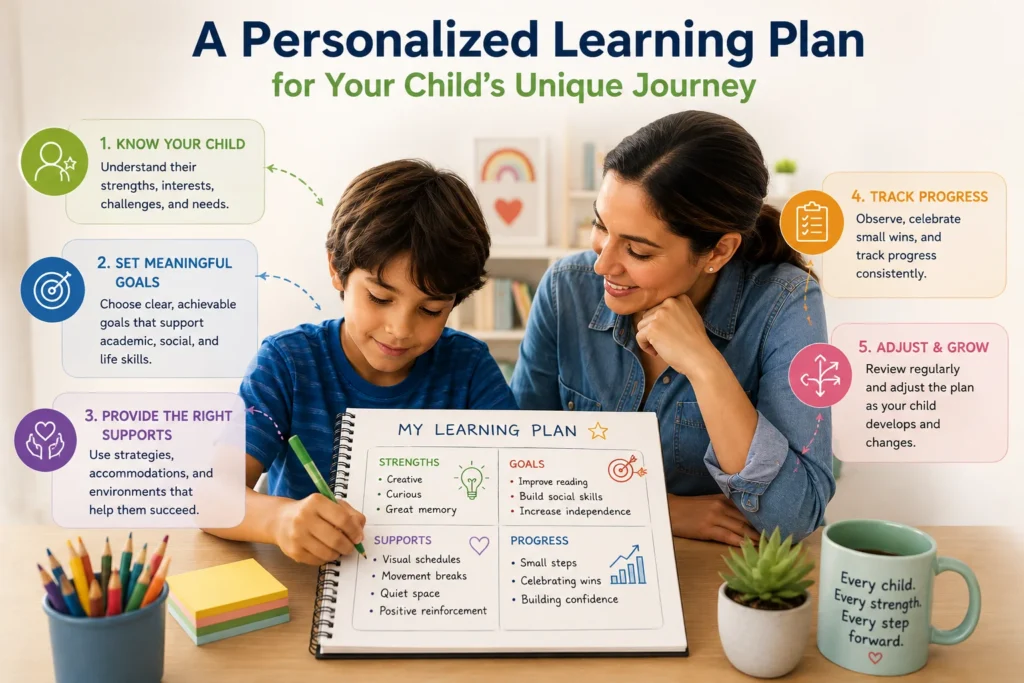
Families and educators can begin with five questions:
1. What are this child’s strengths?
Identify interests, abilities, preferred activities, communication strengths, and situations in which the child feels successful.
2. What skills are the most important to work on right now?
Choose a manageable number of meaningful academic, functional, communication, social, or independence goals.
3. What gets in the way of learning?
Look at environmental, sensory, communication, attention, emotional, or organizational barriers.
4. What supports make learning more accessible?
Identify strategies, accommodations, tools, routines, or environmental adjustments that help the child participate.
5. How will we know whether it is working?
Choose observable indicators of progress and establish a time to review the plan.
This creates a cycle:
Understand → Plan → Support → Observe → Adjust
The plan should evolve as the child develops.
What a Good Learning Plan Should Ultimately Accomplish
An individualized learning plan is not simply a collection of accommodations or a list of academic targets.
At its best, it helps answer a bigger question:
What does this child need in order to participate, learn, develop confidence, and become increasingly independent?
For neurodiverse learners, that may require looking beyond conventional classroom structures and considering the whole learning environment.
A supportive plan recognizes strengths, identifies barriers, establishes meaningful goals, provides appropriate supports, and makes room for the child’s individual pace of development.
That is closely aligned with Adaptive Learning Academy’s broader philosophy: creating an educational environment in which neurodiverse children are seen as capable and supported as individuals. ALA’s model combines specialized expertise, small class sizes, sensory and emotional considerations, and collaboration with families and other professionals.
Final Thoughts
There is no universal learning plan because there is no universal learner.
The most effective approach begins by understanding the individual child: their strengths, interests, communication, sensory needs, challenges, goals, and aspirations.
Parents do not need to create the perfect plan on the first attempt. Start with a few meaningful goals, identify the supports that appear helpful, observe what happens, and adjust over time.
Most importantly, keep the child at the center of the process.
When education adapts to the learner, differences do not have to become barriers to learning. They can become part of the starting point for helping a child discover how they learn, build confidence, and develop greater independence.